There is a particular kind of beauty that only reveals itself when someone tucks their hair behind an ear or lifts it into a loose knot. A vine curls along the curve of the helix. A lotus opens at the nape, its stem trailing down toward the shoulders. Nothing about it is loud, yet it is impossible to forget. That is the quiet magic of fine line ear and neck tattoos for women: they are designs meant to be discovered rather than announced.
The ear and the neck are among the most intimate canvases on the body. They sit close to the face, close to the pulse, close to the places where a whisper lands. A botanical design here feels less like decoration and more like a private language, one that the wearer can show or conceal with a simple shift of her hair. Thin, precise linework suits these spaces beautifully, because the curves of the ear and the long line of the neck invite designs that flow rather than dominate.
In this guide, you will find the symbolism behind botanical ear and neck tattoos, a wide gallery of design concepts described in detail, from floral helix vines and ferns that unfurl along the cartilage to lotus blooms at the nape and cascading wisteria at the side of the throat, plus practical thoughts on style, placement, artist selection and personalization. Whether you are drawn to something barely-there or something intricately layered, you will leave with a clearer sense of which design feels like yours.
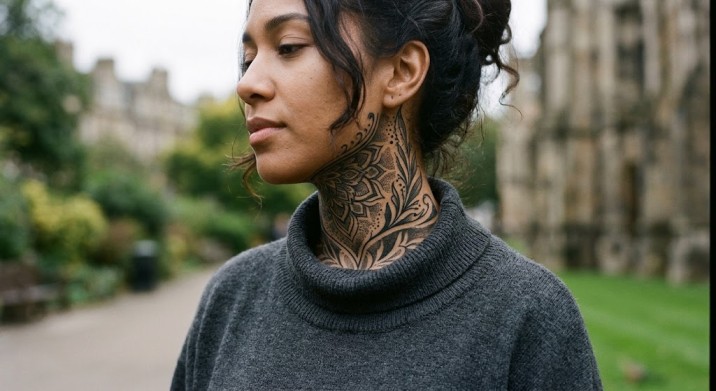
1-Bold Blackwork Mandala Neck Tattoo
The Meaning and Symbolism Behind Botanical Ear and Neck Tattoos
Botanical imagery is among the oldest languages in art. Long before tattoos became a mainstream form of personal expression, people attached meaning to leaves, blossoms, seeds and stems. A few of those meanings are firmly rooted in cultural tradition. Many others are contemporary, personal associations that have grown up around the images over time. It helps to hold both in mind, because the most satisfying tattoos tend to combine a recognized symbol with a private story.
Established associations worth knowing
The lotus is one of the most widely recognized examples. In Buddhist and Hindu traditions, it is often associated with purity and spiritual awakening, partly because it rises from muddy water and opens clean and luminous above the surface. Ferns, with their tightly coiled new fronds, are commonly linked to new beginnings and unfolding growth; in Maori art, the spiral form of the koru, inspired by an unfurling fern frond, carries meanings of new life and renewal. The olive branch has long stood for peace in Mediterranean and Western traditions. Ivy appears in Victorian flower language as a symbol of fidelity and attachment, and rosemary has been associated with remembrance for centuries.
Flower meanings can differ between cultures and eras, so it is wise to treat any single “official” meaning with a little skepticism. If a bloom matters to you for cultural or religious reasons, it is worth reading about its context in the tradition you are drawing from, and speaking with an artist who understands it.
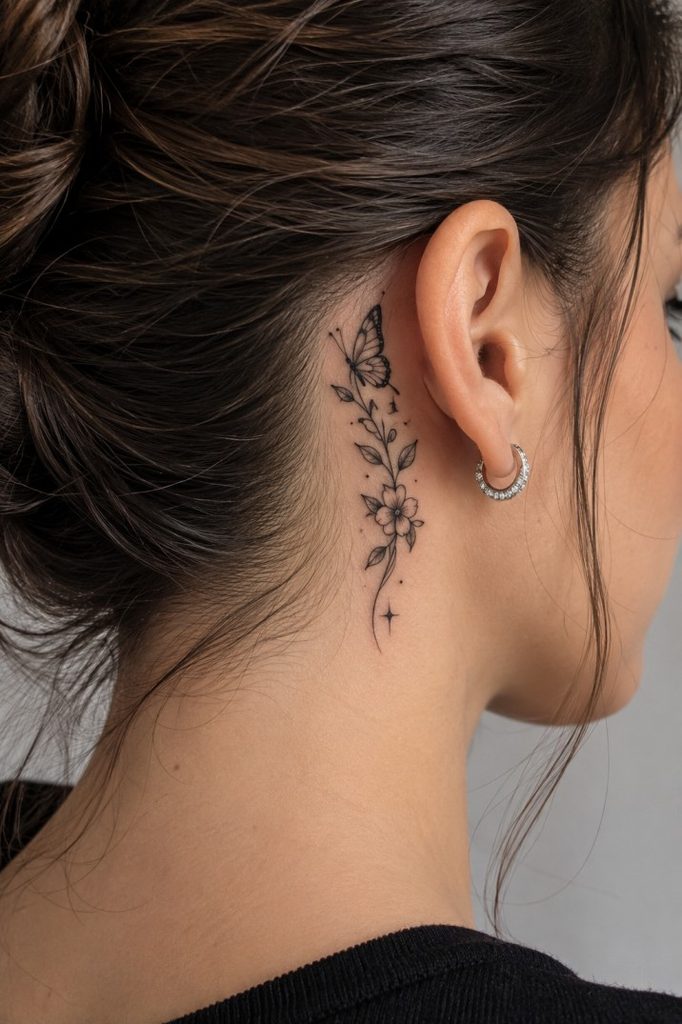
2-Butterfly & Floral Vine Behind-the-Ear Tattoo
Contemporary and personal interpretations
Beyond tradition, botanical tattoos often speak to experiences that are harder to name. A trailing vine can suggest growth that continues even after hardship. A single small blossom can stand for something fragile that survived. Tiny stars scattered around a flower may hint at hope, memory or the feeling of being watched over. These readings are not universal, and they do not need to be. A design means whatever it means to the person who carries it.
Why the ear and neck deepen the meaning
Placement itself is part of the message. A design behind the ear sits in a spot that is often hidden and revealed on the wearer’s terms. A design at the nape is behind you, something you carry but rarely see directly, which many people find poetic: a symbol of resilience or protection that faces the world while you face forward. The neck’s length also encourages upward or downward movement, so a stem can seem to grow, a vine can seem to climb, and petals can seem to drift. Each of these motions can quietly reinforce the idea behind the tattoo.
3-Dainty Moon and Dots Tattoo Near the Eye

Botanical Ear and Neck Designs That Tell a Story
The following concepts are meant as starting points. Each can be shrunk, stretched, simplified or layered, and a skilled artist will adapt the composition to the shape of your ear, the angle of your jaw and the length of your neck.
Designs for the Ear and Behind the Ear
Floral Helix Vine
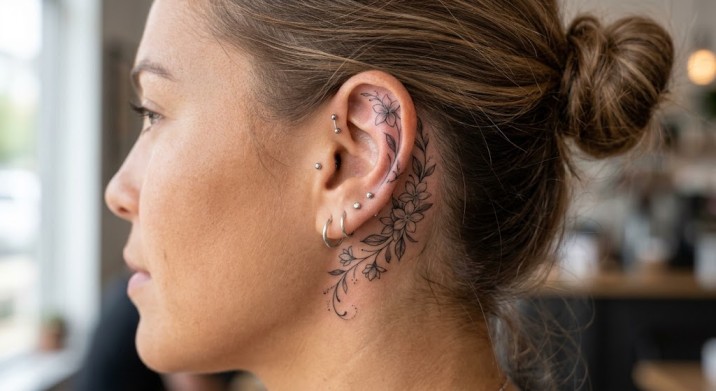
A slender vine climbs along the upper curve of the ear, carrying a few tiny blossoms and leaves that follow the natural arc of the cartilage. The composition is airy and graceful, almost like jewelry that never needs to be removed. It works especially well alongside piercings, because the vine can appear to weave between studs and hoops. The mood is playful yet refined, and it suggests quiet growth that has found its way upward.
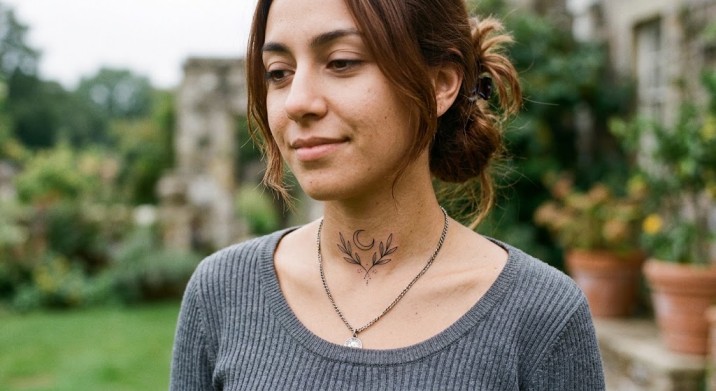
4-Dainty Moon and Leaf Front Neck Tattoo
Behind-the-Ear Trailing Vine
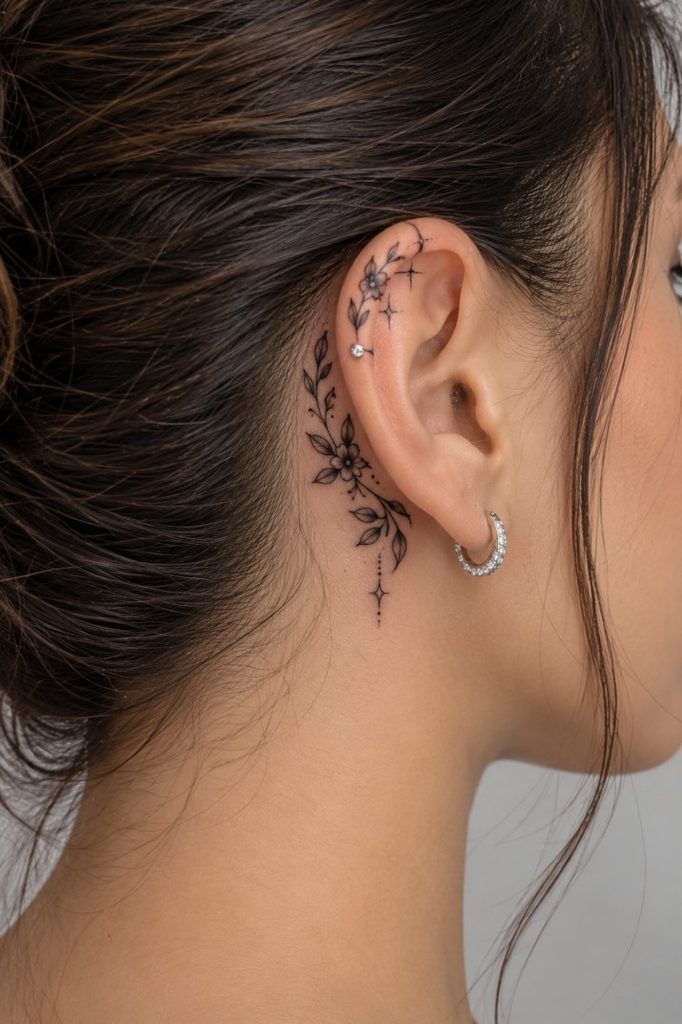
Here, a vine starts near the top of the ear and flows downward along the crease where the ear meets the skull, with leaves alternating on either side and a small flower near the middle. It can end in a teardrop-shaped leaf or a tiny star near the lower edge. The design is gentle and flowing, and it is particularly flattering when hair is worn up, because the line of the neck seems to continue the vine’s descent.
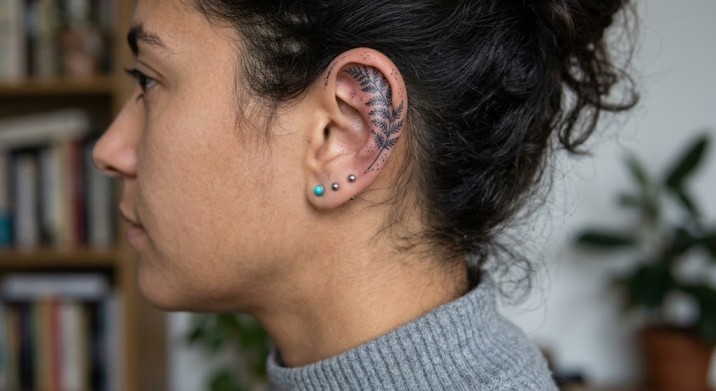
Fern Along the Helix
A fern frond follows the outer rim of the ear, its small leaflets tapering toward a delicate tip. Ferns have a texture that fine-line work renders beautifully, with each leaflet a short, confident stroke. The atmosphere is serene and forest-like. Many people choose this design to represent unfolding, patience and the strength to grow in shaded places.
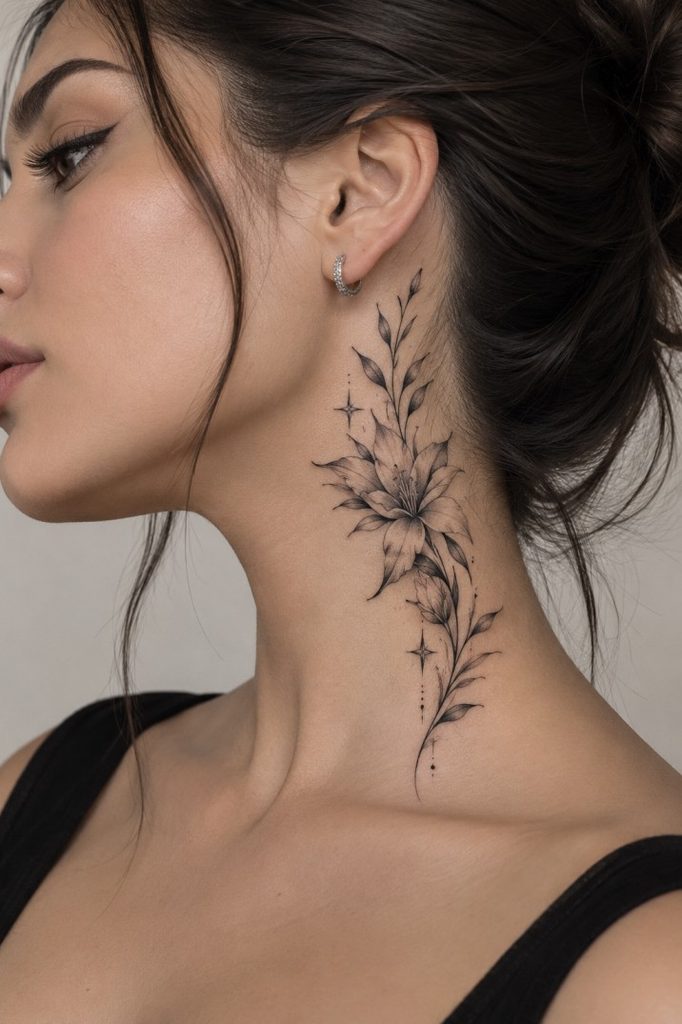
4-Elegant Floral Neck Tattoo for Women
Constellation and Blossom
Tiny four-pointed stars drift around a small flower near the top of the ear, a combination that feels both earthly and celestial. The stars are made from only a few crisp lines, so the design stays extremely light. It suits someone who wants a hint of wonder and a little mystery, and it pairs well with small stud earrings that echo the star shapes.
Crescent Moon and Sprig
A thin crescent cradles a small leafy sprig, placed on the upper ear or just behind it. The contrast between a nighttime symbol and a living plant creates a quiet tension: stillness and growth, darkness and renewal. It can feel meditative and soft, and the compact scale makes it a thoughtful first tattoo.
Olive Branch Behind the Ear
A narrow branch with paired leaves arcs behind the ear, sometimes with one or two tiny olives. The silhouette is clean and symmetrical, and it reads instantly even at a small size. Its association with peace makes it a favorite for people marking the end of a conflict, a reconciliation or a hard-won calm.
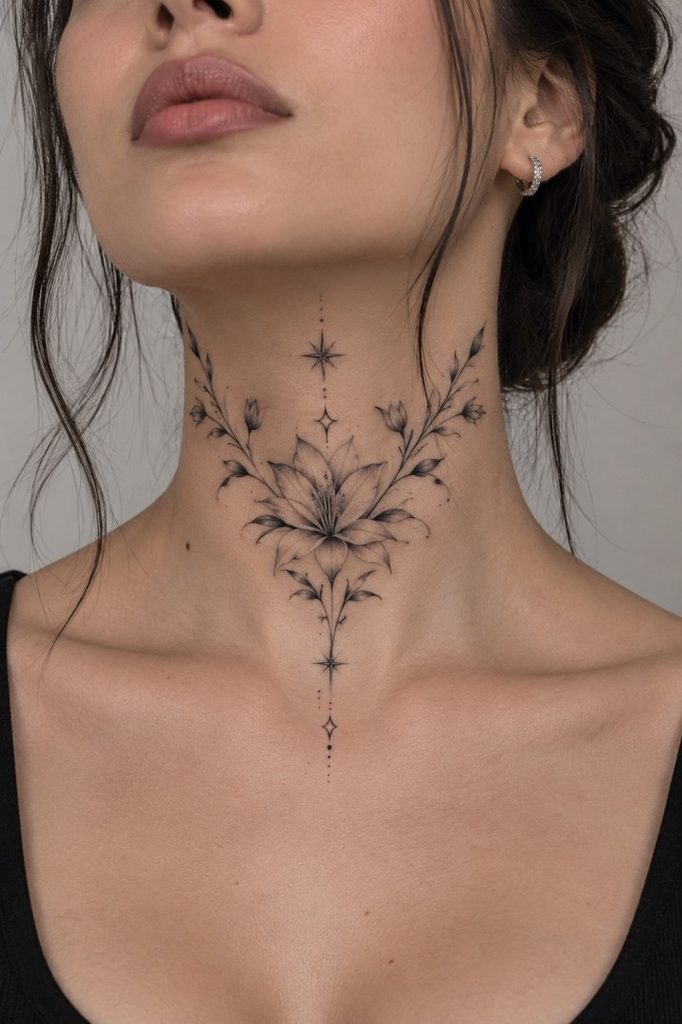
5-Elegant Floral Throat Tattoo for Women
Lavender Stem
A single stem of lavender, with its stacked tiny buds, fits the vertical space behind the ear almost perfectly. The linework can be as simple as a curved line with short flicks along its tip. Lavender is often connected with calm and sleep, so the design tends to feel soothing, like a visual exhale.
Wildflower Cluster on the Ear Lobe and Rim
A few mismatched blooms, perhaps a daisy-like flower, a tiny bud and a stem of grass, scatter lightly across the outer ear. The asymmetry gives it a free, meadow-like personality. It is a good choice for someone whose style leans toward the whimsical and unplanned, and it can grow over time as new flowers are added.
6-Fern & Wildflower Jawline Tattoo Botanical Neck and Face Design
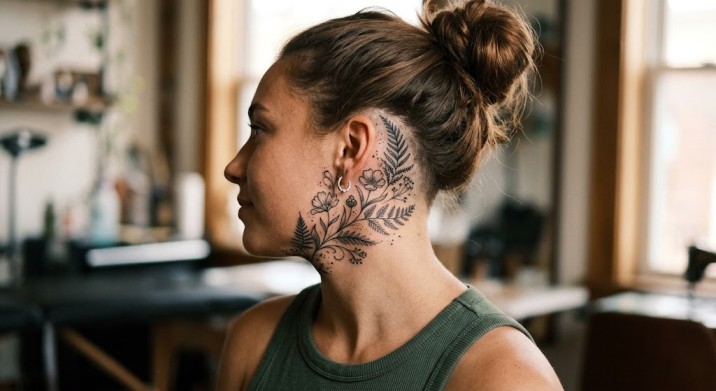
Ivy Tendril
A single ivy vine curls behind the ear with a few pointed leaves and a spiraling tendril at the end. Ivy suggests loyalty and the ability to cling on and climb. The curls give the tattoo movement, which makes it feel alive even at very small size.
Eucalyptus Sprig
Round, coin-like leaves along a gently bowing stem create a design that looks almost sculptural. Eucalyptus has a calm, spa-like reputation, and the tattoo has a similar mood: clean, cool and understated. It works well for someone who loves botanical art but prefers a modern, minimalist look.
Dotted Vine with Single Bloom
Instead of a continuous line, the stem is built from a trail of tiny dots that lead to a single blossom. The effect is delicate and dreamlike, like a path of seeds. It requires a very steady, experienced hand, but the result feels especially soft and ethereal.
7-Fine Line Fern & Floral Head Tattoo
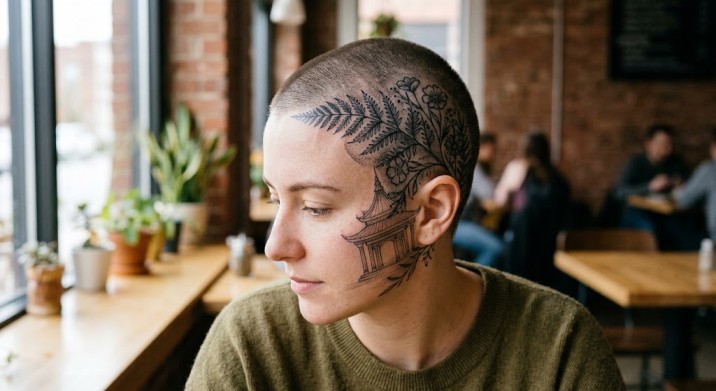
Ear Contour Line with Leaf
A hairline-thin stroke traces the outer edge of the ear and ends in a small leaf or bud. It is the most minimal option here, almost like an outline of an earring. It suits someone who wants the idea of a tattoo without much visible ink, and it works with nearly any hairstyle.
Designs for the Neck and Nape
Fine-Line Lotus at the Nape
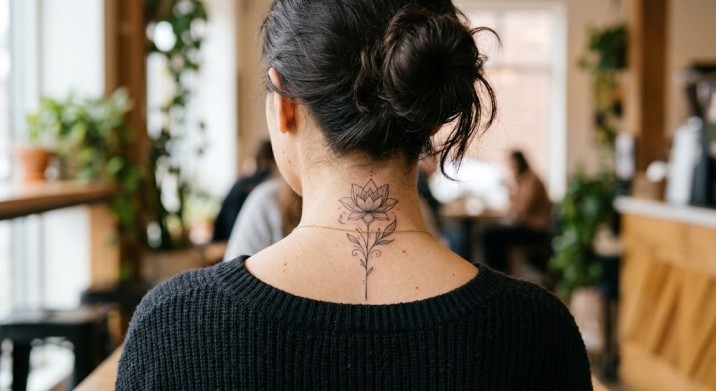
A lotus blooms at the base of the hairline, its pointed petals drawn with the lightest outlines, with a thin stem extending toward the spine. The symmetry suits the center of the neck, and the upward-opening flower seems to rise from the shoulders. It is a design associated with awakening and resilience, and it has a calm, graceful presence that reads beautifully when the hair is pinned up.
Spine-Trailing Vine from the Nape
A vine begins at the nape and continues down the upper spine, with leaves and tiny blossoms branching off at irregular intervals. It can stay short or extend across the back. This is a design for someone who wants movement and a sense of journey, as the vine seems to travel with her.
8-Fine Line Fern Ear Tattoo
Peony at the Nape
A fuller, ruffled flower, drawn with soft layered curves, sits near the base of the neck. Peonies are often linked with abundance and romance, and the layered petals offer a beautiful chance to play with linework density. The result feels lush yet still delicate, a good balance for someone who wants more presence without heavy shading.
Side-Neck Jasmine Spray
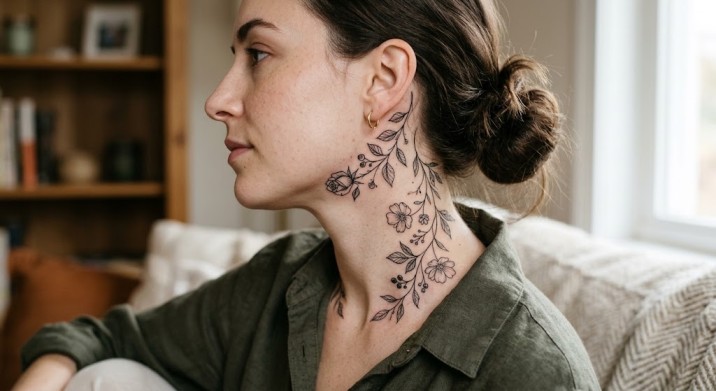
A small branch of jasmine, with star-shaped flowers and pointed leaves, curves from just below the ear toward the collarbone. Jasmine is known for its fragrance, and the design has a sensory, almost perfumed quality. The placement follows the neck’s natural diagonal, so it looks effortless.
9-Fine Line Floral Front Neck Tattoo
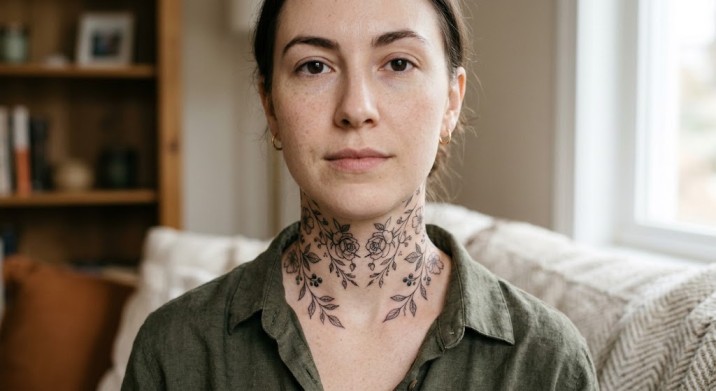
Cascading Wisteria
Clusters of tiny blossoms hang from a vine just below the ear, dropping in a graceful cascade along the side of the neck. The downward flow echoes the way hair falls, and the design has a romantic, almost cinematic atmosphere. It suits someone who loves dramatic softness.
Birth Flower at the Hairline
A small bloom representing a birth month, or the birth month of a loved one, is placed just beneath the hairline at the back of the neck. Because the design is small and personal, it can be a quietly powerful tribute. A tiny stem or a few leaves can anchor it, and a small date or initial can be woven into the stem if desired.
Hairline Sprigs
Short botanical sprigs trace the line where the hair meets the neck, as if a few stems had been tucked in by hand. The effect is subtle and clever, almost like a delicate necklace worn at the back. It is a good fit for people who want a design that peeks out under shorter hairstyles.
10-Fine Line Floral Vine Ear Tattoo
Moth or Butterfly Among Leaves
A fine-line butterfly or moth rests on a leaf or small blossom at the side of the neck. The winged figure adds themes of transformation and fragility, and nestling it inside foliage keeps the botanical focus. It is a charming choice for anyone marking a period of change.
Moon Phases with Botanical Stems
A slim row of moon phases is connected by a vine that runs vertically along the nape or the side of the neck. The cycle of the moon suggests renewal and the passing of time, while the vine ties it back to earth. The look is celestial yet organic and works well for someone drawn to ritual and rhythm.
11-Fine Line Floral Vine Neck Tattoo
Cherry Blossom Branch
A small branch with a handful of open blossoms and buds sweeps across the side or back of the neck. Cherry blossoms are widely associated with the fleeting nature of beauty, especially in Japanese culture, where they are tied to the beauty of impermanence. The tattoo feels tender and reflective, a gentle reminder to cherish the present.
Dandelion Seeds Drifting
A dandelion head at the nape releases a handful of seeds that float upward toward the hairline or sideways along the neck. This design is cheerful and wistful at once, associated with wishes, letting go and resilience. The scattered seeds also give the artist room to create motion without heavy detail.
12-Fine Line Lotus Back of Neck Tattoo
Rosemary Sprig of Remembrance
A narrow, needle-leaved sprig rests along the side of the neck or behind the ear. Because rosemary has long been connected to remembrance, it is a quiet way to honor someone who has passed. The linework is simple and elegant, and it can be paired with a tiny initial or date.
Single-Line Rose
A rose drawn in one continuous flowing line, with a stem that curls into a gentle loop, sits at the nape or side of the neck. It is modern, graphic and minimal, and the unbroken line adds a sense of calligraphy. It appeals to people who love classic symbols treated in a contemporary way.
13-Floral Ear Tattoo with Behind-the-Ear Vine Fine Line Set
Magnolia Bloom with Falling Petals
A broad, sculptural magnolia flower rests at the side of the neck, with a couple of petals drifting down along the shoulder. Magnolias are often seen as symbols of perseverance and dignity, because they bloom early and boldly. The design is elegant and stately, with a calm confidence.
Climbing Vine Around the Neckline
A vine curves around the back of the neck like a living necklace, leaf by leaf, with small buds at irregular points. It can be placed higher for a choker effect or lower for a collar-like silhouette. This is a design for someone who enjoys jewelry-inspired tattoos and wants an organic alternative to a chain.
14-Floral Throat Tattoo for Women
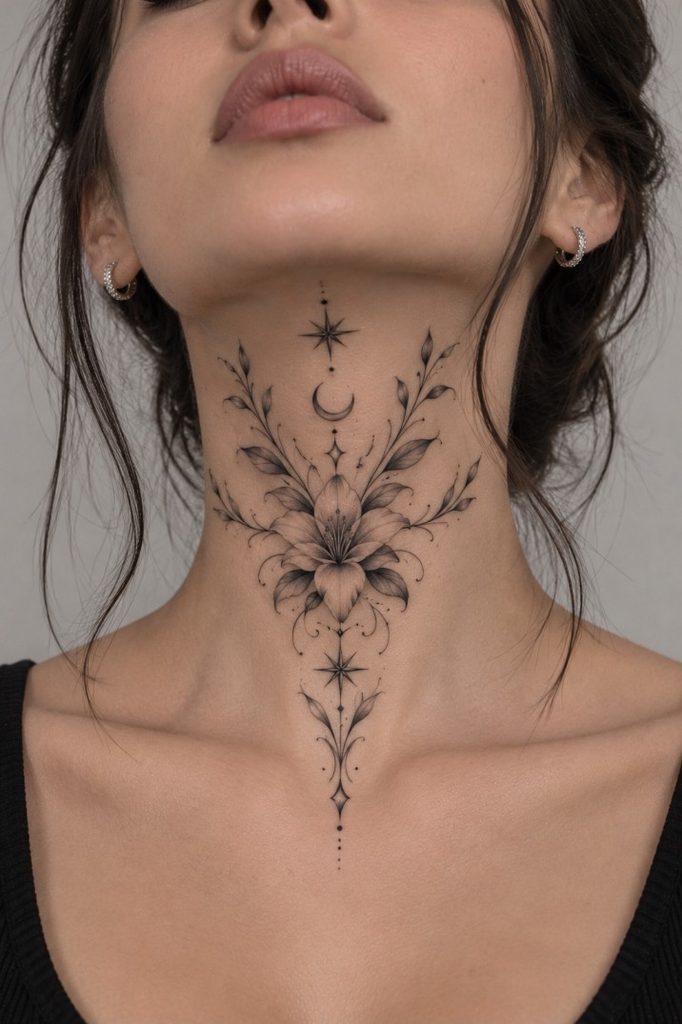
Choosing a Style That Reflects Your Story
Two people can choose the same flower and end up with entirely different tattoos, because style changes everything: the mood, the visibility, the way the piece ages and the way it sits against the skin. Thinking about style before you commit to a motif often clarifies what you want more than the motif itself.
Fine-Line and Single-Needle Work
This is the style most closely associated with delicate ear and neck tattoos. Using very slim needle configurations, the artist builds designs from crisp, slender strokes that look almost like pencil sketches or ink-pen botanical illustrations. The charm lies in restraint: a leaf is a curve and a small flick, a petal is a single arc. Fine-line work lets the shape of the ear and neck stay in the foreground, so the tattoo feels like a natural extension of the body rather than a separate object. It is worth knowing that very thin lines can soften or spread slightly as skin changes over the years, so a design with a little breathing room between lines tends to age more gracefully than one with tiny, tightly packed details.
15-Floral Vine Wrapping the Ear Butterfly Behind-Ear Tattoo
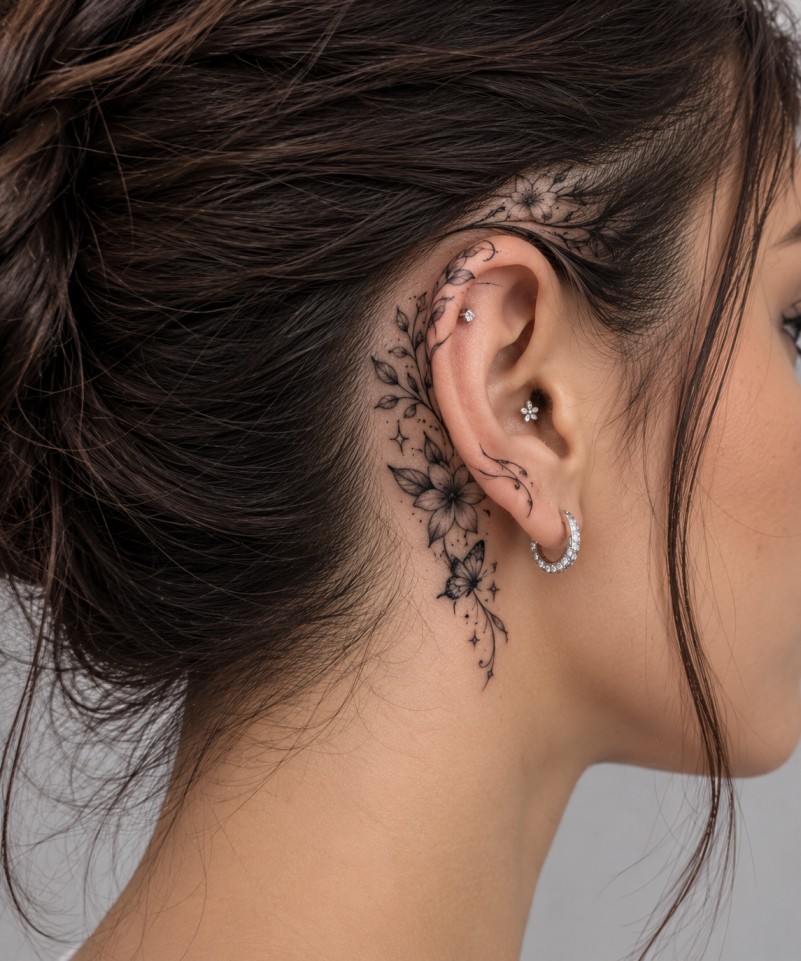
Micro-Botanical and Minimalist
Minimalist botanical tattoos strip a plant down to its essential gesture: one stem, one bloom, one curve. They suit people who love the idea of a tattoo but want it to remain understated. Because there is so little on the page, the proportions and spacing matter enormously, and a good artist will spend time getting the angle of a leaf or the curve of a stem exactly right. These designs are often chosen for the ear, where space is limited and where a single sprig can feel complete.
Black and Grey Softness
Adding a whisper of soft, diffused shading to a fine-line design can give petals and leaves a gentle sense of depth without making the tattoo heavy. Light grey wash can suggest the curl of a petal or the shadow beneath a leaf, bringing a botanical illustration quality to the piece. Because the ear and neck are small areas, restraint is key; a little shading goes a long way, and too much can make the design look crowded.
16-Flowing Botanical Neck Tattoo Delicate Wildflower Vine
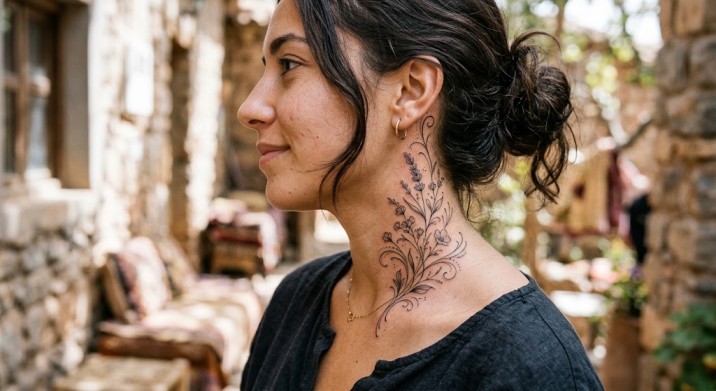
Ornamental and Jewelry-Inspired
Some of the most beautiful ear and neck tattoos echo jewelry: chains of tiny leaves, necklace-like vines, dotted lines that behave like beaded strands and small clusters that mimic earrings. This approach blends botanical imagery with ornamental design, and it can be a delightful way to give the body decoration that never needs to be taken off. It pairs especially well with real piercings, since the tattoo and the metal can be planned to complement each other.
Dotwork and Stippled Details
Dots can add texture and softness to a design. Used sparingly, they can suggest pollen, falling seeds, starlight or the soft shadow beneath a bloom. Dotwork pairs naturally with fine-line botanical work and gives it a dreamy, slightly vintage atmosphere.
17-Ornamental Face Tattoo Ideas
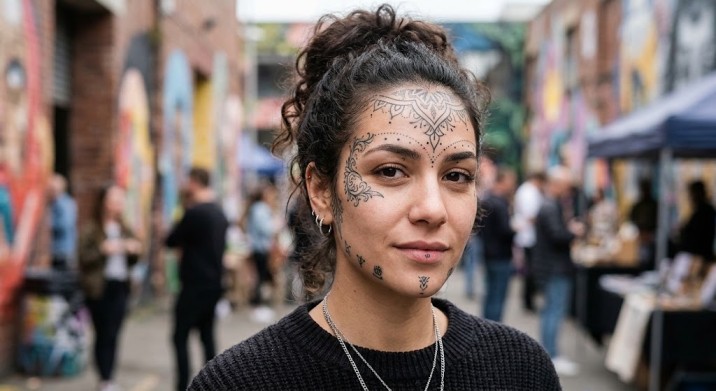
Illustrative and Engraving-Inspired
If you love antique botanical plates, an illustrative approach may appeal to you. Fine parallel lines and careful cross-hatching can give a leaf the look of an old scientific engraving. This style takes more space and skill than pure minimalism, so it often works better on the side of the neck or the back of the neck than on the smaller surface of the ear.
Matching Style to Personality
If you are naturally quiet and prefer subtlety, minimalist and micro-botanical styles will probably feel like home. If you love texture and romance, a soft, shaded or ornamental approach might suit you better. If you enjoy a more vintage sensibility, dotwork or engraving-inspired designs may be the most satisfying. There is no correct answer; the best style is the one you will still love when it has become part of your daily reflection in the mirror.
18-Small Fine Line Floral Face Tattoo with Leafy Stems
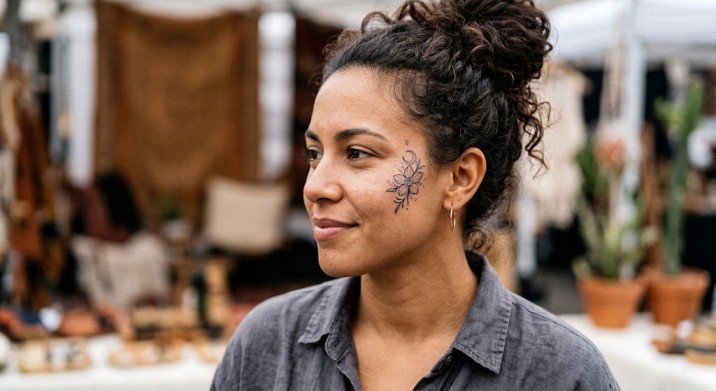
Where to Place Your Tattoo
Placement determines how a design is seen, how it moves with you and how it fits into your everyday life. With ear and neck tattoos, small changes in position can change a design’s mood entirely.
The Helix and Outer Ear
The helix, the upper outer rim of the ear, is ideal for narrow, linear designs such as vines, ferns, olive branches and tiny dotted trails. Because the cartilage is thin and curved, the artist must adapt the drawing carefully to the shape of your ear, and the design is typically kept compact. Designs here are visible from the front when hair is worn back, and they pair beautifully with piercings. It is worth remembering that ear cartilage and skin can behave differently from flatter areas of the body, and some people find the ear more sensitive. Experiences vary widely, so it is more helpful to talk through your concerns with your artist than to rely on general promises about comfort.
19-Small Fine Line Moon Branch Tattoo for the Cheekbone
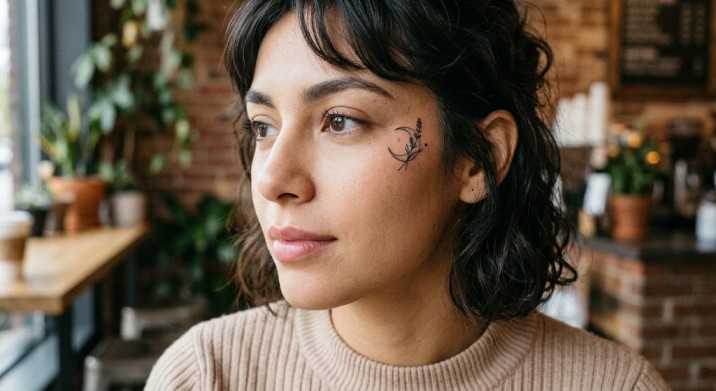
Behind the Ear
The space behind the ear is one of the most popular places for delicate botanical work. It offers a small, relatively smooth canvas that is visible when hair is pinned up and hidden when it is worn down. It suits trailing vines, small sprigs, crescent moons and little constellations. Because this area can be affected by friction from glasses, headphones, hats and hair, it is wise to think about your daily habits and plan your aftercare accordingly.
The Ear Lobe and Inner Ear Details
Tiny motifs can sit on the lobe or the inner folds of the ear, but these areas are very small and the skin can be more challenging to tattoo. Fine details may fade or blur sooner here, so many artists recommend keeping the design extremely simple and being prepared for touch-ups down the line.
20-Statement Throat Tattoo with Ferns, Blossoms & Symbols

The Nape and Back of the Neck
The nape is one of the most flattering places for a centered, symmetrical design such as a lotus, a peony or a dandelion releasing its seeds. It offers a little more room than the ear, which makes it possible to include stems, falling petals and subtle shading. It is naturally concealed by long hair and revealed by updos, giving the wearer complete control over the moment of reveal. Because the nape is behind you, it is a place many people associate with symbols of strength or protection.
The Side of the Neck
The side of the neck suits diagonal and cascading designs like wisteria, jasmine and cherry blossom branches, because the long curve between ear and collarbone gives them room to flow. This placement is more visible than the nape, and it is often chosen by people who are comfortable with their tattoo being part of their everyday look. If you work in a setting with dress code considerations, it is worth thinking through visibility before committing.
21-Symmetrical Botanical Throat Tattoo with Geometric Gem Accents

Along the Hairline
Sprigs and tiny buds placed along the hairline create a distinctive, almost embroidered effect. Hair growth and hairstyles, including short cuts and shaved areas, can change how visible these designs are, so consider how you usually wear your hair and how it may change.
Scale, Flow and Practical Considerations
A few practical principles can help you plan:
- Let the body lead the design. The best botanical tattoos follow the curve of the ear or the line of the neck, rather than sitting on top of it as a flat image.
- Think about movement. The neck bends, turns and stretches. Designs placed near joints or creases should be tested visually in different positions, often with a temporary drawing or stencil.
- Consider daily friction. Collars, scarves, hair accessories, headphones and glasses can all rub against these areas, and sun exposure can affect the look of tattoos over time. Sunscreen is a sensible habit once the tattoo has fully healed.
- Plan for evolution. Fine linework can soften with time, and many people choose to refresh details after healing. A small, simple design is easier to maintain than a dense one.
22-Tiny Crescent Moon & Flower Behind the Ear Tattoo
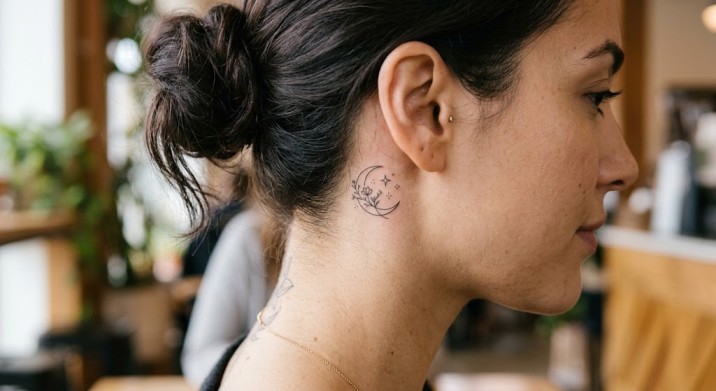
Working With the Right Artist
Fine-line botanical work on the ear and neck demands steadiness, precision and a good eye for anatomy. A few tips can help you find the right match.
- Study healed work, not only fresh photos. Fresh tattoos always look crisp. Ask to see healed examples of fine-line pieces to understand how the artist’s work settles over time.
- Look for botanical sensitivity. The best botanical tattooists understand how plants grow, how leaves attach to stems and how petals overlap. Anatomical accuracy is not required, but a sense of natural logic makes designs feel alive.
- Discuss the stencil openly. A good artist will place a stencil on your ear or neck and let you look at it in a mirror, moving it until it feels right.
- Ask about aftercare. Healing instructions vary from artist to artist, and the ear and neck have their own challenges. Follow your artist’s guidance, and speak with a medical professional if you have skin conditions or concerns.
- Choose a licensed, hygienic studio. This is non-negotiable. Take time to confirm that the studio follows proper safety and sterilization practices.
23-Tiny Leaf Sprig & Crescent Moon Back of Neck Tattoo
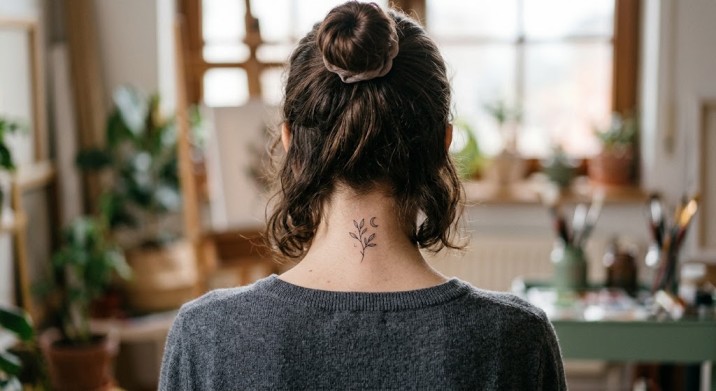
How to Make Your Tattoo Feel Personal
A beautiful design becomes a meaningful one when it carries something only you can recognize. The ear and neck are small spaces, so personalization works best through subtle touches rather than extra elements.
Hide a Date, Initial or Coordinate in the Details
A tiny roman numeral can become part of a stem. An initial can appear as the shape of a leaf vein. The coordinates of a meaningful place can be hinted at through the placement of small dots. These details are invisible to most people but unmistakable to you.
Use Negative Space
Leaving small gaps in a design can create subtle shapes: a crescent made from the empty space between leaves, a tiny star in the center of a flower or a break in a stem that suggests a path. Negative space keeps fine-line tattoos airy and makes them feel more thoughtful.
Combine Symbols Thoughtfully
Combining a lotus with a few small stars, a fern with a tiny crescent or an olive branch with a single bloom can produce a design with layered meaning. Keep the combination simple: in small spaces, each element needs room to be seen.
Finding the Design That Speaks to You
The most memorable ear and neck tattoos are rarely the ones with the most detail. They are the ones that feel inevitable, as though the vine had always been growing there, waiting for someone to notice. A blossom behind the ear, a lotus resting at the nape or a fern tracing the curve of the helix can say a great deal precisely because it says it softly.
As you browse, pay attention to the images that make you pause. Notice whether you are drawn to the lightness of a dotted vine, the calm symmetry of a nape flower or the sweeping drama of a wisteria cascade. Notice the stories you tell yourself about each one. Those small flickers of recognition are usually a better guide than any list of meanings.
When you are ready, bring your favorite references, your thoughts about placement and the personal details you would like to weave in to an artist whose work you admire. Let them translate your story into line and shape. Then, when your hair is tucked behind your ear on an ordinary morning and a small garden catches the light, you will know the design is exactly yours.