
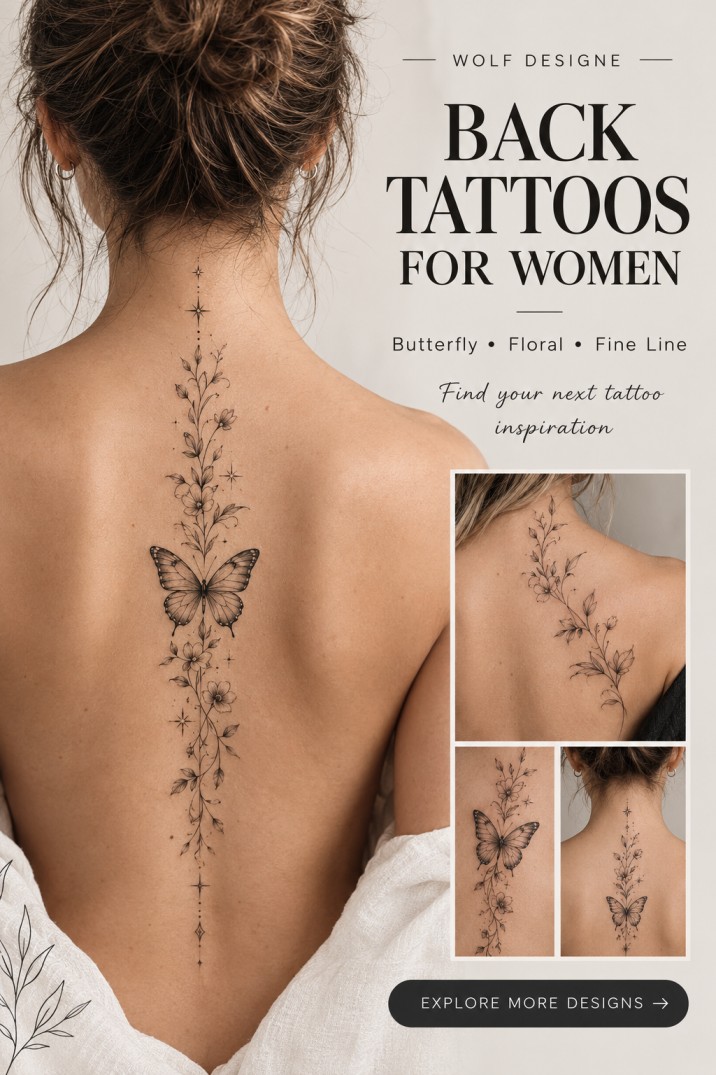
Nobody sees their own back the way everyone else does. It is the one landscape of your body you can only meet in fragments: a glimpse in a bathroom mirror, a photograph a friend sends, the way a stranger’s glance lingers when your hair is swept into a loose bun and a summer dress falls low. That quiet paradox is exactly what makes back tattoos for women so haunting. They are made to be noticed by the world and known intimately by you, a private story carried in plain sight across the longest, most open canvas the body offers.
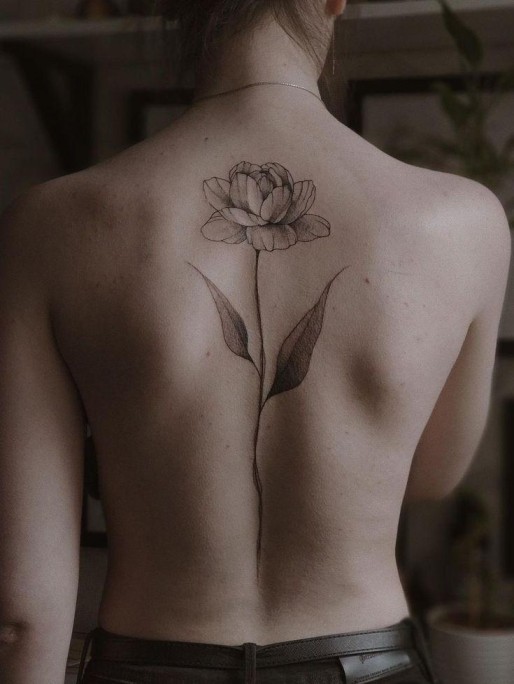
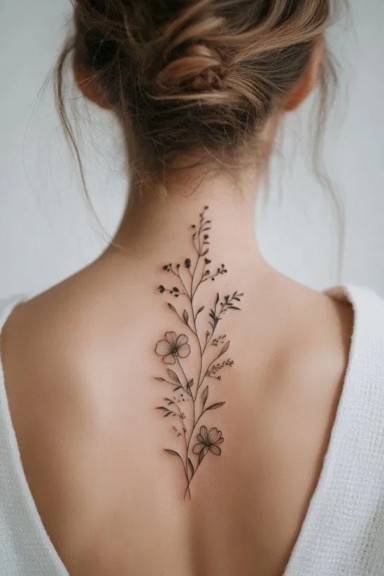
1-Back of neck tattoo
From a single flowering vine climbing the spine to a drift of wildflowers settling over a shoulder blade, the most captivating back tattoos share a certain grace: they follow the body rather than sit on top of it. A butterfly alights where the shoulder blades meet. Petals unfurl along the vertebrae like a slow-motion bloom. Tiny stars and dotted lines trail toward the nape of the neck like the final notes of a melody. Done well, the design stops looking like decoration and starts looking like an extension of posture, movement, and personality.
This guide explores the symbolism that gives these designs their emotional weight, then walks through a collection of distinct concepts, from spine tattoos with butterflies and blossoms to delicate floral branches on the shoulder blade and celestial lines that glow like constellations. You will also find honest advice on choosing a style, deciding where to place your tattoo, making the design unmistakably yours, and preparing for a conversation with your artist. Whether you are drawn to fine-line elegance, botanical storytelling, or a quiet minimalist mark, consider this a place to wander, save what moves you, and recognize the story you want to wear.
2-Between shoulder blades tattoo
The Meaning and Symbolism Behind Back Tattoos for Women
Before choosing a design, it helps to understand why the back holds such emotional power. Symbolism in tattoo art comes from several layers: long-standing cultural traditions, shared contemporary associations, and the deeply personal meanings each wearer brings. A good rule is to treat established symbolism as a starting point and your own memories as the final word. No design carries a single universal meaning, and the most meaningful tattoos are often the ones whose significance only the wearer fully understands.
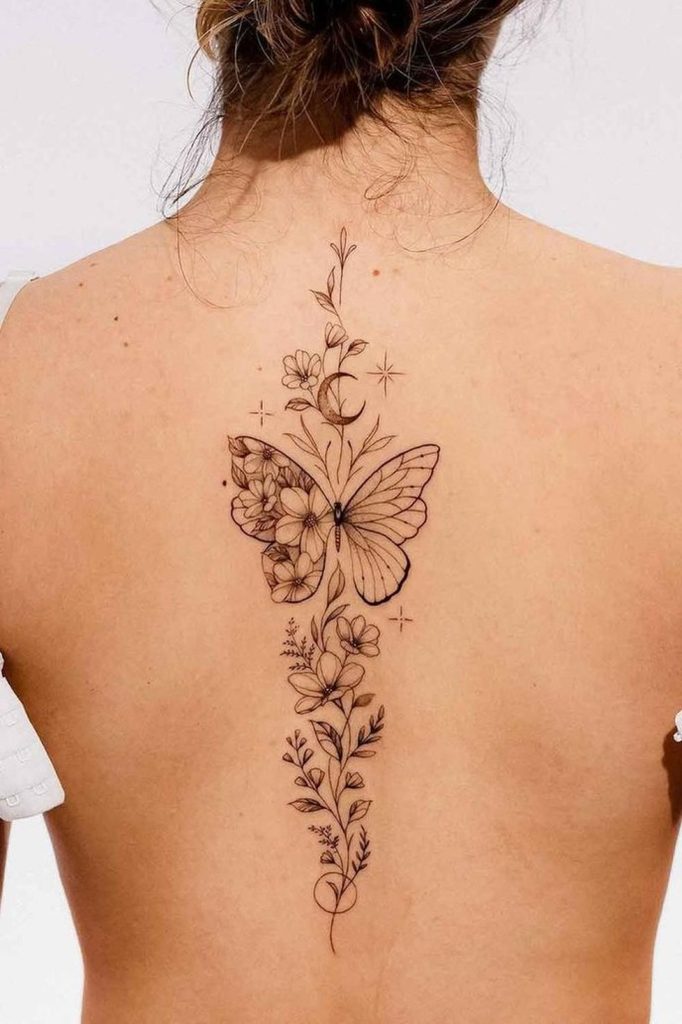
3-Butterfly & Flowers Back Tattoo
The Back as a Canvas of Trust
The back is the part of the body we cannot guard with our eyes. We face the world front-first; what lives behind us is a matter of trust, memory, and what we have already survived. Many people describe back tattoos as a way of honoring what supports them, the people who stand behind them, the experiences they have carried, or the strength that has held them upright. This is an interpretation rather than a rule, but it explains why designs placed along the spine so often feel like a statement about resilience, stability, and the quiet architecture of a life.
There is also a practical emotional truth: because you cannot constantly see a back tattoo, it becomes something you carry rather than something you check. It is there in photographs, in mirrors, in the reactions of people close to you, but it does not demand your attention. For many, that gentle distance makes the tattoo feel more like a secret companion than an accessory.
4-Elegant Floral Spine Tattoo
The Butterfly: Transformation, Freedom, and Becoming
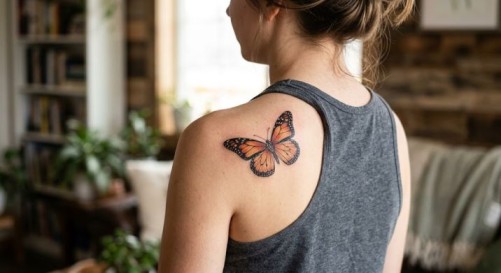
Few symbols appear on women’s back tattoos as often as the butterfly, and for good reason. Its life cycle, from crawling larva to sealed chrysalis to winged flight, has long served as a metaphor for change. In many cultures and contemporary interpretations, the butterfly stands for transformation, renewal, and the courage to emerge from a difficult season as someone new. In some traditions it has also been associated with the soul or with remembered loved ones, though these associations vary widely and should be treated as possibilities rather than fixed meanings.
On the back, the butterfly gains an extra layer of poetry. Its symmetrical wings echo the symmetry of the body itself, and its placement between the shoulder blades can suggest wings that have always been there, waiting. Rendered in fine linework with softly shaded wing patterns, a butterfly feels fragile and fearless at once.
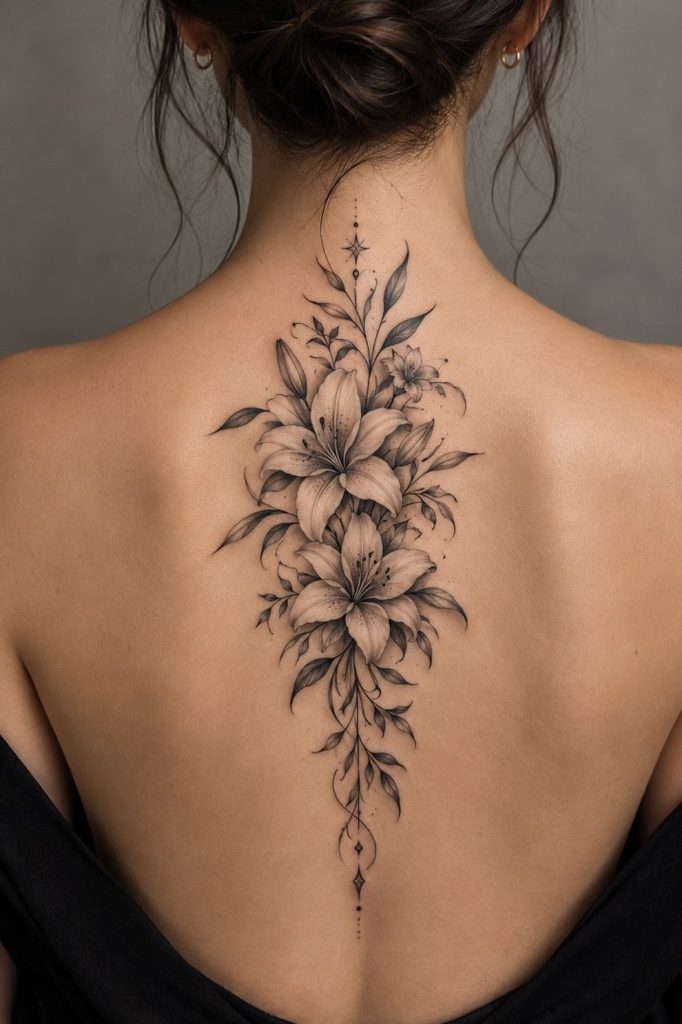
5-Elegant Lily Upper Back Tattoo for Women
Flowers: Resilience, Femininity, and Growth
Floral imagery is the other great language of back tattoos. Flowers have been used across centuries of art to speak of beauty, cycles of life, tenderness, and endurance. Today, a blooming flower is often read as hidden strength: something soft that nonetheless pushes through stone, survives winter, and returns. Individual blossoms carry their own traditional associations. Roses are linked with love and passion, lilies with purity and remembrance, lavender with calm, and wildflowers with freedom and unplanned beauty. Birth flowers add another personal layer, since each month has traditional flowers connected to it.
When flowers are arranged as a climbing vine or cascading stem, they also express something about time. A bud near the nape, a half-open bloom at the middle, a full flower near the lower spine: the design can quietly narrate a journey from beginning to flourishing.
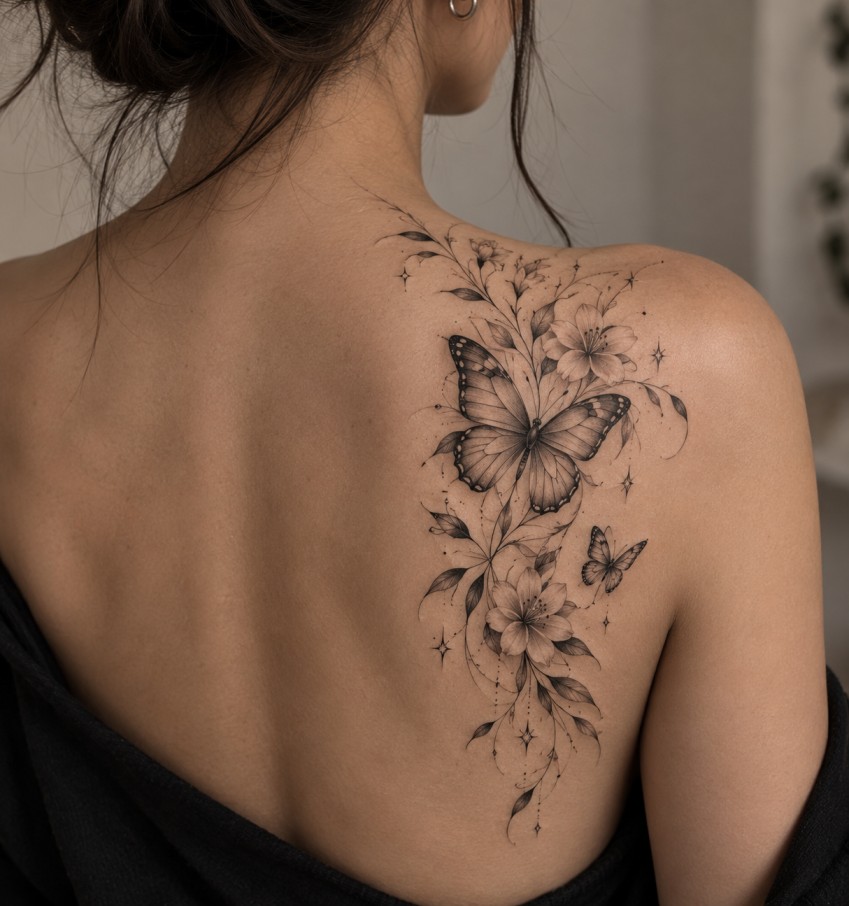
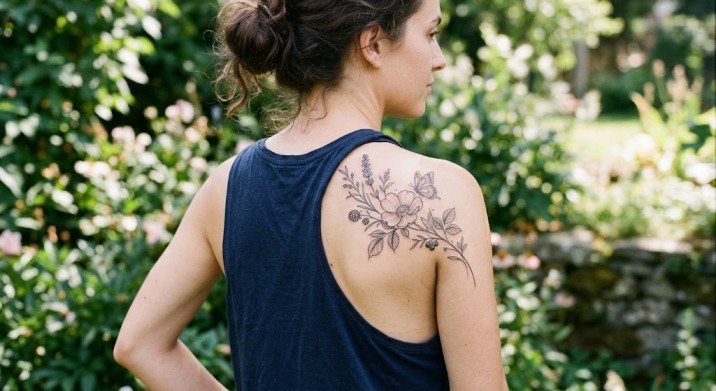
6-Fine Line Butterfly & Blossom Shoulder Blade Tattoo
Stars, Dots, and Celestial Details
The tiny sparkles, four-pointed stars, and dotted lines that often accompany spine tattoos do more than fill space. Stars are traditionally linked with guidance, hope, and the idea of finding direction in the dark. Dots and dashes can suggest a path, a pulse, or the passing of time. Moon imagery is often connected with cycles, intuition, and emotional tides. In a fine-line composition, these elements work like punctuation, giving the main design room to breathe and leading the eye smoothly along the length of the back.
Vines, Branches, and Leaves: Roots, Reaching, and Renewal
Vines and branches carry a sense of motion. A vine reaches, climbs, and clings; a branch extends outward while remaining anchored. For many wearers, these forms speak of growth, connection to family or heritage, and the willingness to keep reaching toward light. Leaves, especially delicate ones with visible veins, add a sense of texture and seasons. Trailing foliage along the spine can feel like the body itself is sprouting, a quiet image of life continuing.
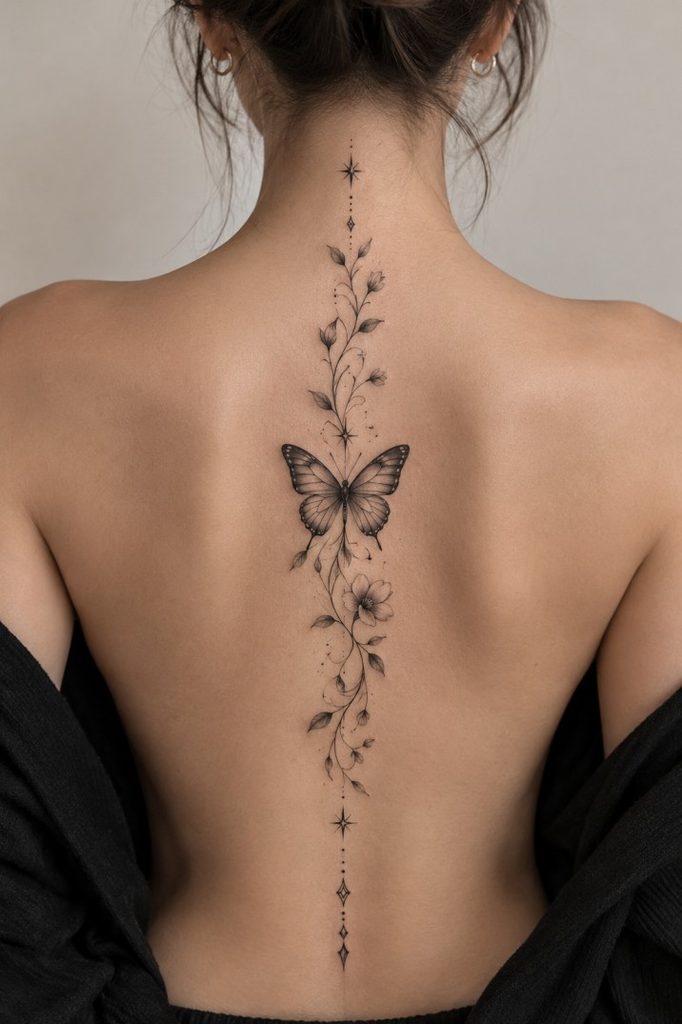
7-Fine Line Butterfly Spine Tattoo with Stars & Vines
A Note on Cultural Traditions and Personal Meaning
Some symbols have specific roles within particular cultural, religious, or spiritual traditions, and those meanings deserve respect and research. If you are drawn to a symbol from a tradition that is not your own, take time to learn its history, speak with artists familiar with it, and consider whether it fits your story. For most contemporary fine-line and botanical designs, meanings are far more flexible. What matters is that the symbolism rings true for you, and that you can explain it, or choose not to, with confidence.
Back Tattoos for Women: Designs That Tell a Story
The following concepts are starting points rather than templates. Each can be adjusted in scale, flower choice, style, and placement. Consider them a gallery of possibilities, then notice which ones you keep returning to in your mind.
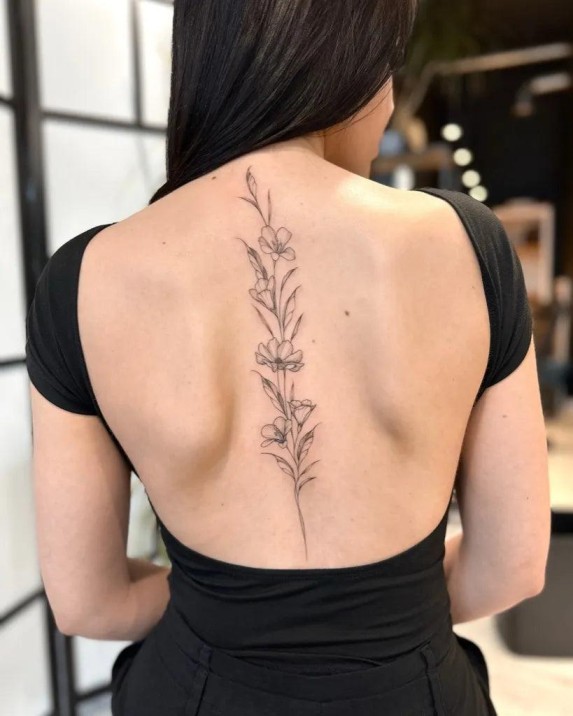
8-Fine Line Wildflower Spine Tattoo
The Butterfly and Blossom Spine Vine
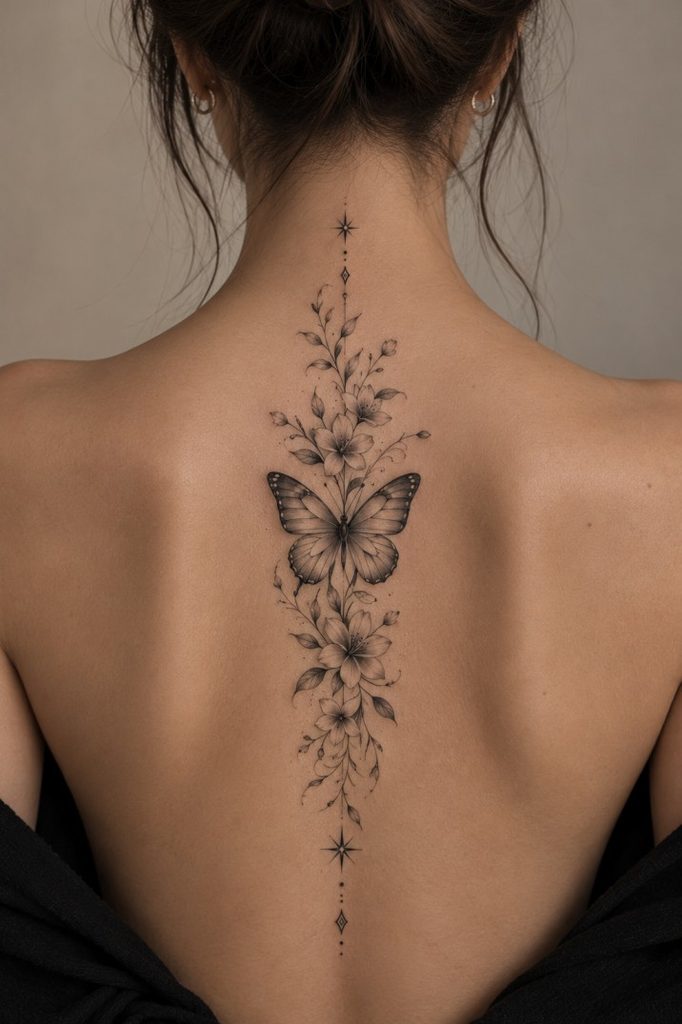
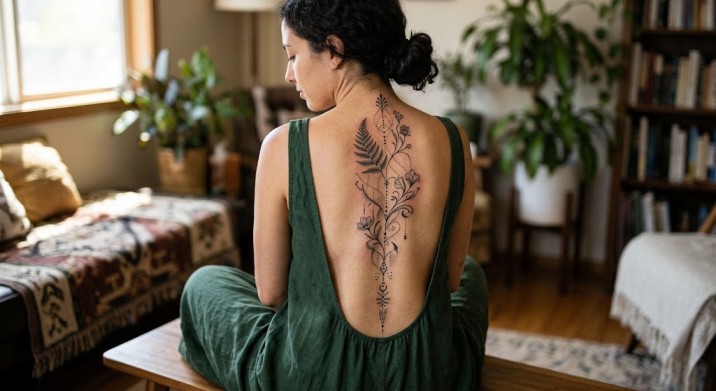
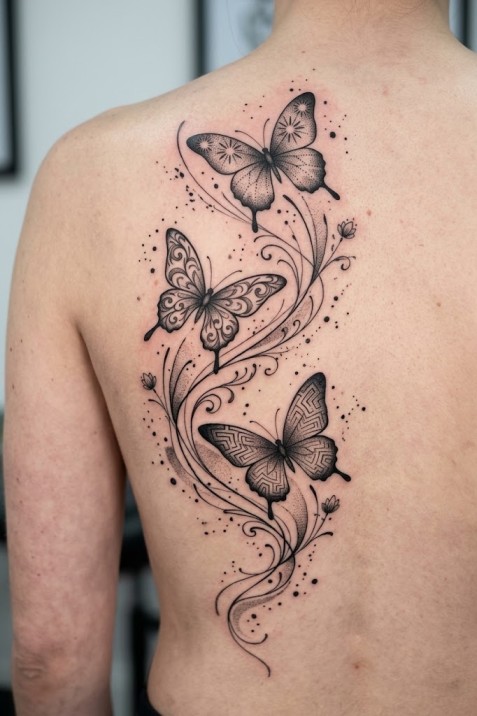
This is the quintessential spine tattoo for women who love botanical romance: a slender vine of small flowers and leaves rising from the lower back to the nape, with a single butterfly resting near the center of the composition. The butterfly acts as a focal point, its wings shaded with fine stippling and delicate veining, while the flowers above and below it taper in size so the design seems to grow naturally from the body.
The emotional atmosphere is tender, transformative, and quietly luminous. The butterfly suggests change, the flowers suggest flourishing, and the vertical line of the vine echoes the spine itself. Small four-pointed stars and tiny dots at the top and bottom can extend the design into a soft, dreamy trail. What makes this concept distinctive is its balance: the butterfly brings weight and drama, while the vine keeps everything light and graceful. It works beautifully as a long, narrow piece and is one of the most flattering options for hair worn up.
9-Floral Shoulder & Spine Tattoo
The Celestial Spine Line
Imagine a thin line of tiny stars, sparkles, and dots running from the base of the neck down the length of the spine, spaced like a constellation drawn with a single steady breath. This is minimalism at its most poetic. There is no heavy focal image, only rhythm: larger four-pointed stars at intervals, smaller sparkles between them, and delicate dotted segments that connect the pattern.
The mood is serene, hopeful, and slightly mystical. Many wearers connect this design with guidance, wishes, or the idea of carrying light through darker periods. It is a particularly good choice for first-time tattoo wearers or anyone who prefers understated beauty, because it can be built in stages and extended later with flowers, a moon, or a small butterfly if the desire grows.
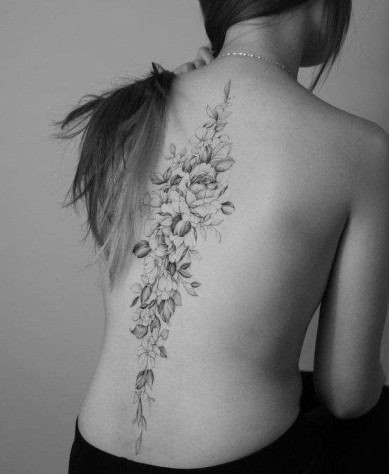
10-Full Back Botanical Tattoo
The Shoulder Blade Botanical Branch
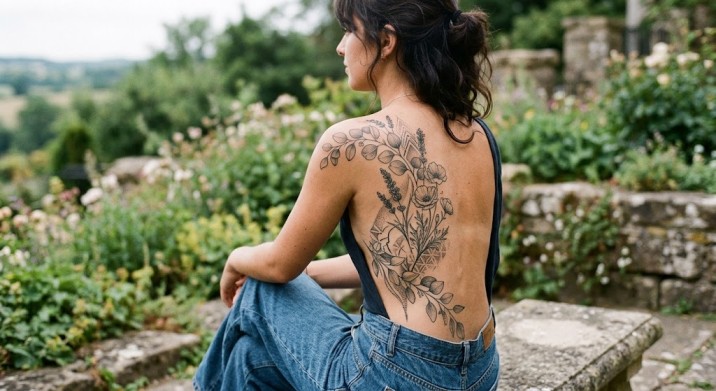
Not every back tattoo has to run down the center. A diagonal branch of leaves, buds, and open blossoms that sweeps from the nape across one shoulder blade creates a fluid, asymmetrical composition that moves like wind through a garden. The stem curves with the natural slope of the shoulder, small leaves fan outward, and a few blooms open near the widest part of the blade.
The atmosphere is airy, organic, and gently wild. This design celebrates movement and imperfection, which makes it ideal for people who find perfect symmetry too formal. Because it follows the shoulder line, it peeks out from necklines and straps in an eye-catching way, offering a glimpse rather than a full reveal. It is also an excellent canvas for botanical illustration techniques, where each leaf has individual shading and delicate veins.
11-Full Back Floral Tattoo for Women
The Nape-of-the-Neck Floral Cluster
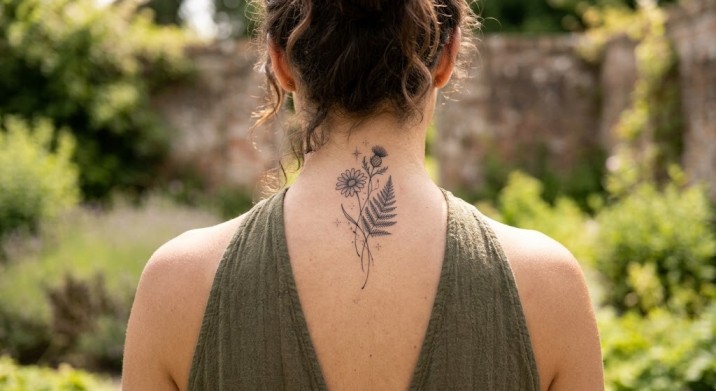
A small bouquet of blossoms or a single flower with trailing stems, placed at the base of the neck, is a tattoo meant to be discovered. It sits just beneath the hairline, framed by the curve of the neck, and appears when hair is lifted or tied back. The design might include a cluster of tiny flowers, a cascading sprig, or a miniature butterfly hovering above a bloom.
The feeling here is intimate and secret, like a note tucked into a pocket. It suits people who want a meaningful tattoo that remains easy to conceal for professional or personal reasons. Because the area is compact, simplicity is key: fewer, more deliberate lines tend to age and read more clearly than crowded detail.
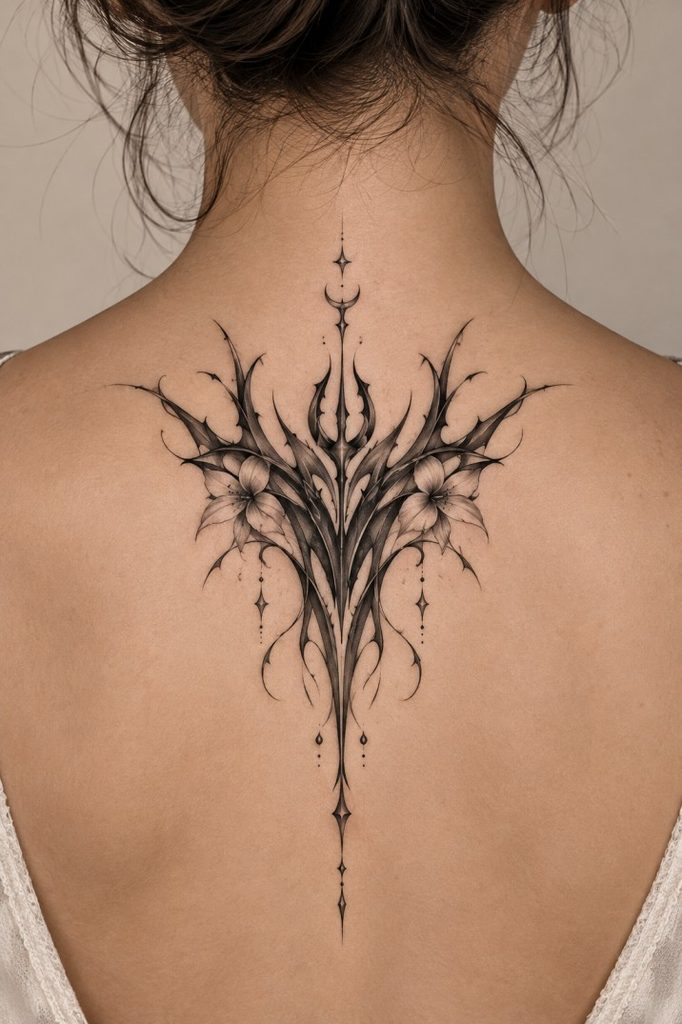
12-Gothic Floral Spine Tattoo
The Cascading Full-Back Bouquet
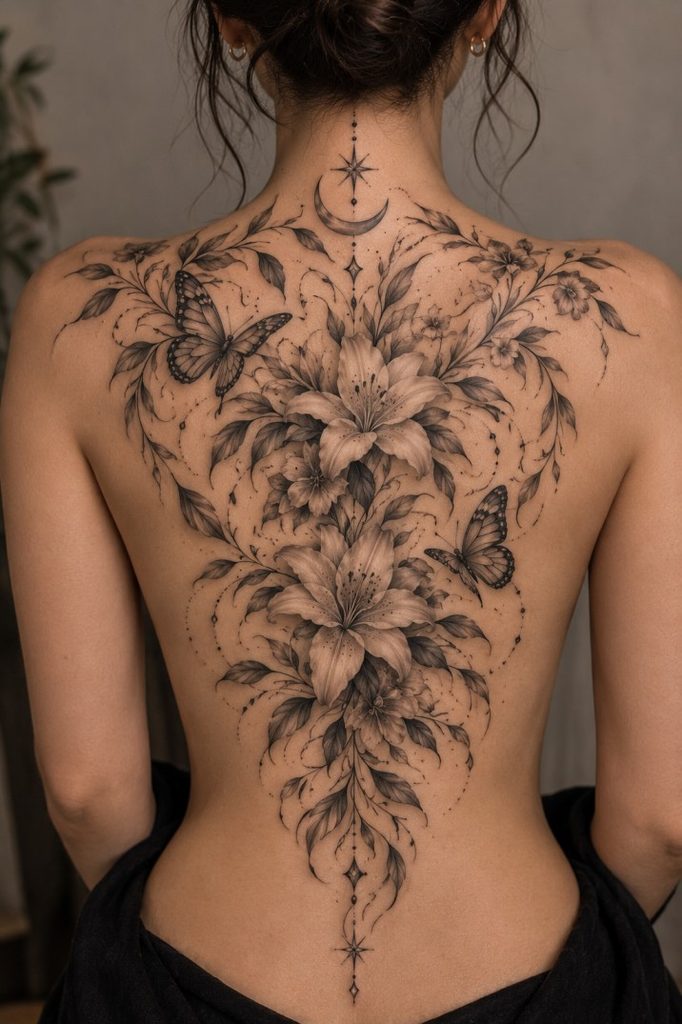
For those ready for a statement piece, a large floral composition can span the entire upper and mid back, with blossoms of varying sizes tumbling down from the shoulders and gathering toward the center. Peonies, magnolias, roses, wildflowers, and ferns can be woven together with leaves and buds to create depth and movement. The negative space between flowers, which is skin left untouched, becomes part of the design, letting light and shadow play across the back.
The atmosphere is lush, abundant, and celebratory. This concept reads like a personal garden, each flower chosen for a reason: a birth month, a family memory, a favorite place. Its distinctive power comes from scale and storytelling. It is an investment in time and collaboration, often built across multiple sessions, but it rewards that patience with a composition that feels truly unique.
13-Monarch Butterfly Tattoo Shoulder Blade Color Design Guide
The Winged Butterfly Pair Across the Shoulder Blades
Instead of one butterfly on the spine, imagine a pair of delicate butterflies hovering near the shoulder blades, one slightly higher than the other, as if caught mid-flight. Their wings can be detailed with fine line patterning, subtle shading, or open outlines with a few ornamental flourishes. Tiny dotted flight paths trailing behind them add a whimsical sense of motion.
This concept can suggest companionship, sisterhood, or the idea of becoming and flying together. It also carries a gentle symbolism for mothers and daughters, close friends, or two chapters of one life. Because the butterflies sit symmetrically on either side of the spine, the design frames the back beautifully without covering the spine itself, which some people prefer for comfort or aesthetic reasons.
The Ornamental Filigree Spine
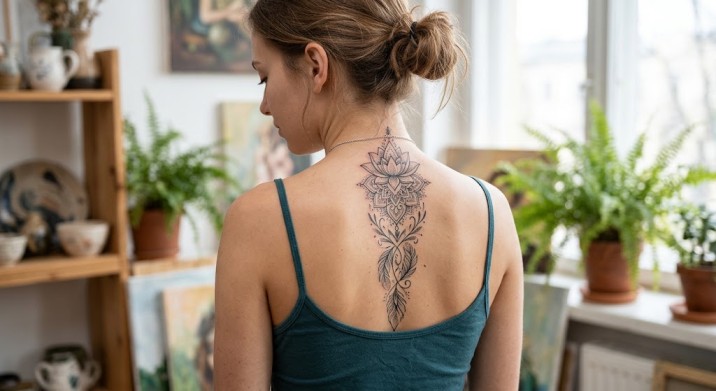
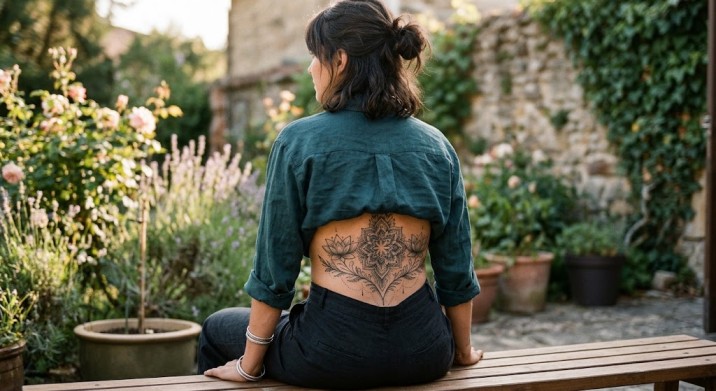
Borrowing from lace, jewelry, and architectural ornament, this design runs down the spine in a symmetrical pattern of curls, beads, tiny petals, and delicate scrollwork. It can resemble a necklace worn backward or a piece of vintage filigree that has settled into the skin. Some versions include a small centered gem-like shape, a crescent, or a tiny flower at the focal point.
The mood is elegant, regal, and refined. It speaks to those who love detail and craftsmanship, and who see their tattoo as a form of body adornment. Ornamental designs are especially striking in black and grey, where crisp linework and fine dotwork create a jewel-like effect. They can also blend beautifully with botanical elements for a hybrid of formal and natural beauty.
14-Ornamental Back Tattoo
The Memorial Bloom
Some back tattoos are written in remembrance. A single flower, perhaps a loved one’s birth flower or a bloom they cherished, can be placed over the heart side of the upper back or along the spine, with a tiny date, initials, or a short word in delicate script nearby. A few falling petals or a dotted line rising upward can suggest memory drifting skyward.
The emotional atmosphere is tender, reflective, and deeply personal. Here, subtlety is a strength: the design does not need to explain itself to be powerful. It is also a design that can grow over time, adding a second flower for another loved one, a butterfly for new beginnings, or a vine to connect memories into a continuous story. Because the back is a place we carry rather than constantly see, many people find it a comforting home for remembrance.
15-Shoulder blade tattoo
The Wildflower Meadow Along the Rib-Side of the Back
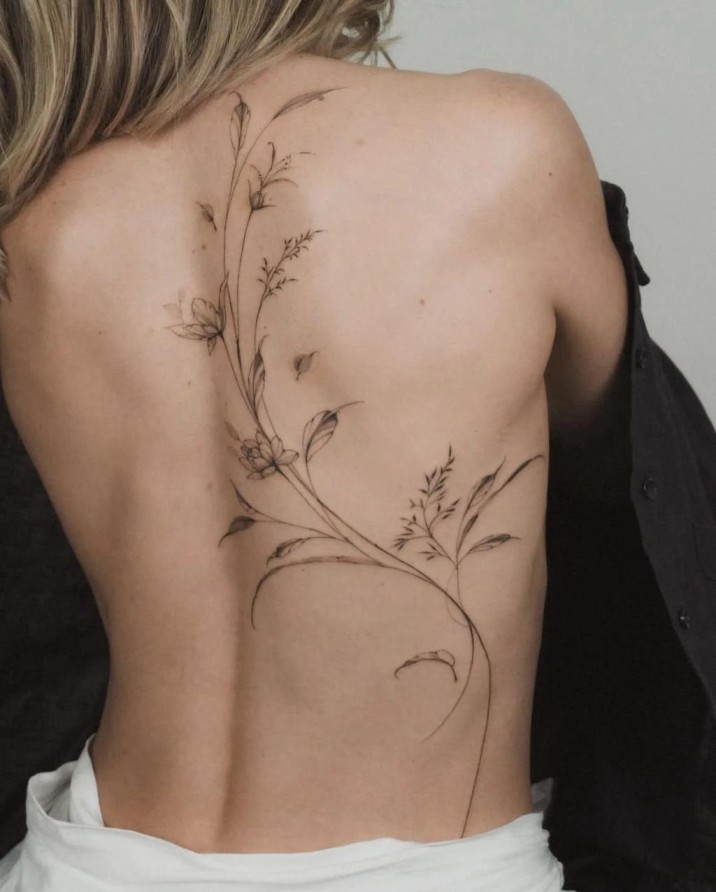
Rather than centering on the spine, this concept lets a loose collection of wildflowers, grasses, and seed heads rise from the lower side of the back, near the ribs, like a meadow caught in a breeze. Stems vary in height, some bending, some straight, with occasional tiny insects or a single butterfly drifting above the blooms.
The feeling is free-spirited, nostalgic, and sunlit. It speaks to people who find beauty in the untamed, the unplanned, and the imperfect. Its distinctive quality is its relaxed asymmetry: it looks as though it simply grew there. This design pairs well with a larger botanical story and can be extended upward later without losing coherence.
16-Side back tattoo
The Moon Phase Spine
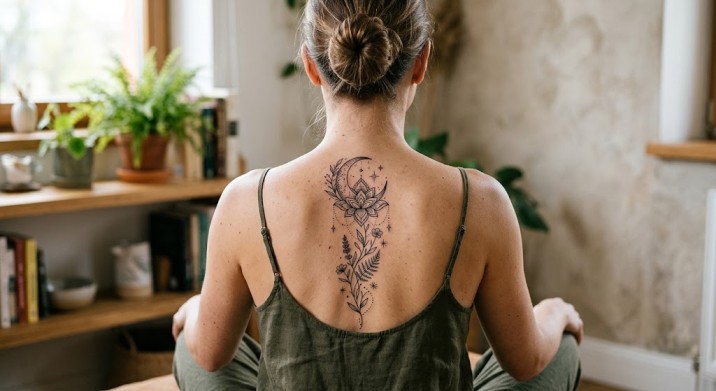
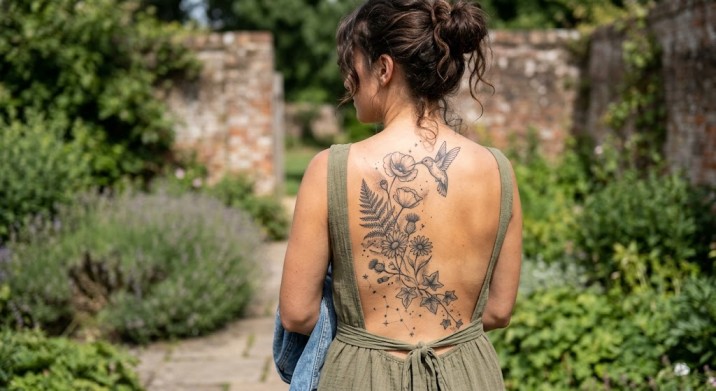
A vertical sequence of moon phases, from crescent to full and back again, can be paired with small stars, tiny leaves, or a single flower at the center. Each moon is rendered with delicate linework or soft shading, and spacing is generous enough to let the pattern feel like a quiet ritual drawn along the spine.
The atmosphere is contemplative, cyclical, and softly mystical. Moon phases are often associated with change, intuition, and the repeating rhythms of life, making this design appealing to those who see their personal growth as a series of cycles rather than a straight line. It is dignified in its restraint and ages well when drawn with clear, uncluttered shapes.
Choosing a Style That Reflects Your Story
Two tattoos with the same subject can feel completely different depending on technique. The style you choose shapes mood, longevity, and the way the design interacts with your skin. Here are the approaches most often used for women’s back tattoos.
17-Symmetrical Butterfly & Blossom Spine Tattoo
Fine-Line Tattoos
Fine-line work uses slender needles and light, precise strokes to create designs that look as if they were drawn with a sharp pencil. It is the signature style of delicate botanical spine tattoos, tiny stars, and softly detailed butterflies. The result is airy and elegant, with a gentle presence that suits people who want beauty without heaviness. Because lines are thin, the artist’s skill is critical: steady hands and thoughtful spacing keep the design crisp. It is wise to ask your artist about how fine-line work typically settles over the years, since very thin lines and tiny details can soften with time, sun exposure, and skin changes. A good artist will often suggest slightly bolder linework or more open spacing in places where longevity matters most.
Black and Grey Shading
Black and grey tattoos use graduated tones, from deep shadow to the faintest wash, to give shape and dimension. On a butterfly, this might mean soft shading in the wing cells and darker accents along the veins; on a flower, it might mean curved shadows that make petals appear to lift off the skin. This style brings richness and depth, and it pairs beautifully with fine-line outlines. It is a strong choice for larger back pieces, where contrast helps the design read clearly from a distance.
18-Upper spine tattoo
Botanical Illustration
Inspired by vintage plant studies and scientific drawings, botanical illustration tattoos emphasize accuracy and grace: leaf veins, stamens, seed pods, and layered petals rendered with care. This style rewards patient collaboration, especially if you want specific flowers that are meaningful to you. It also lends itself to storytelling, since each plant can represent a person, a place, or a moment.
Ornamental and Dotwork
Ornamental tattoos build patterns from curls, beads, mandala-like shapes, and repeating details, while dotwork constructs shading from countless tiny points. Together they create a jewelry-like effect that feels timeless. These styles work especially well down the spine, where symmetry is natural and the pattern can unfurl like a pendant or a delicate chain.
19-Mandala & Lotus Lower Back Tattoo
Minimalist Mark-Making
Minimalist back tattoos strip a concept down to its essentials: a single line, a lone sprig, a small crescent, a handful of stars. The appeal is restraint. A minimalist design leaves room for the body to stay the main character, and its quiet nature makes it easy to live with. If you are unsure, minimalism is a gentle starting point that can be expanded later.
Soft Realism and Micro-Realism
Some artists specialize in creating tiny, highly realistic images, such as a butterfly with convincing wing texture or a rose with lifelike petals, at a small scale. These pieces are visually stunning, but they require exceptional skill and a realistic conversation about how fine details may age. If you love this look, review healed work in an artist’s portfolio, not only fresh photographs, so you can see how their tattoos settle over time.
20-Fine Line Poppy & Lavender Back Tattoo
Where to Place Your Back Tattoo
Placement is not just a practical decision; it determines how the design moves with you, how it frames your silhouette, and who sees it and when. The back offers an unusual range of possibilities.
Along the Spine
The spine is the most iconic placement for women’s back tattoos, and it is easy to see why. A vertical design lengthens the torso, draws attention to posture, and creates a natural centerline that suits symmetrical or gently curving compositions. Spine tattoos can be short, ending between the shoulder blades, or long and flowing from the nape to the lower back. Because the spine is a bony area with thin skin over it, many people find the sensation more intense there than on fleshier parts of the body, though experiences vary widely from person to person. Talk with your artist about how they approach this area and how to schedule breaks if you are planning a long design.
21-Fine Line Fern & Wildflower Spine Tattoo
The Nape and Upper Back
The nape is ideal for small, discreet designs and for the beginnings of a spine piece. It is also a high-visibility area when hair is up, so consider how the tattoo will look with different hairstyles and clothing. Designs here work best when they are compact and intentional, with simple silhouettes that read clearly even at small scale.
The Full Back
A full-back composition is the most ambitious option, covering the entire canvas with a single cohesive story. It is a long-term collaboration and typically requires many sessions. The reward is a design planned as a whole, with elements that flow naturally across the body and a sense of completeness that is difficult to achieve piece by piece.
Echo Your Own Shape
The best back designs respect the individual. A skilled artist considers your shoulder width, spine curvature, posture, and proportions, then draws a design that moves with you rather than against you. Do not be afraid to ask for adjustments: a slightly narrower vine, a butterfly rotated a little, or flowers shifted to follow the line of your shoulder can make an enormous difference.
Working With Your Artist: Preparing for the Consultation
Great tattoos are collaborations. Choosing the right artist is as important as choosing the right design, particularly for fine-line, botanical, and micro-realistic work, which depend on technical precision.
- Study portfolios closely. Look for artists whose work resembles the style you want, and pay special attention to healed photographs that show how their tattoos look after settling.
- Bring references, not instructions. Share images that capture the feeling you want, whether that is the softness of a flower, the elegance of a line, or the mood of a composition. Then let the artist interpret them in an original design.
- Explain your story. Even a brief description of what the tattoo means to you helps the artist choose shapes, spacing, and details that serve your intention.
- Ask about placement and flow. A stencil placed on your skin lets you see how the design sits and moves. Take your time, stand naturally, move your shoulders, and look from different angles.
- Prioritize safety and comfort. Choose a licensed, reputable studio with clean practices and open communication. You should feel free to ask questions about everything from equipment hygiene to aftercare.
- Be patient. Good artists are often booked in advance, and rushing can compromise the result. A carefully planned tattoo is worth the wait.
How should I care for a back tattoo?
Follow your artist’s specific aftercare instructions, since recommendations vary. Because the back is hard to reach, you may want to ask a trusted person to help with cleaning and moisturizing as directed. Over the long term, sun protection helps keep linework and shading looking their best. If you notice signs of irritation or infection, contact a medical professional.
22-Idée de tatouage papillon élégant dans le dos
Finding the Design That Speaks to You
Back tattoos for women are, at their best, a conversation between art and anatomy. A vine follows the spine because the spine invites it. A butterfly rests between the shoulder blades because that is where wings would grow. Stars trail upward because the body already leans toward light. The most unforgettable designs never feel imposed; they feel discovered, as if they were waiting under the skin all along.
As you browse, save, and imagine, pay attention to the images that make something in you go quiet. Notice whether you are drawn to the transformation of a butterfly, the tenderness of a blossoming branch, the calm rhythm of a celestial line, or the intricate beauty of ornament. Those reactions are clues. They point toward the story you are ready to carry, and the story you may already be living.